For just one time I would take the Northwest Passage; How will the legal status of the Canadian archipelago shape the future of the Arctic environment (konferenca "ClimateXLaw")
*Author: Erazem Ivanc**
Abstract: The article is based on a poster presentation given at the 2026 ClimateXLaw Conference. It outlines the question of the legal status of the Northwest Passage, between Canadian internal waters and an international strait. In the light of recent arctic ice shrinkage, it aims to give the reader an outline of applicable legal regimes and their consequences for the protection of Canadian Arctic environment.
Keywords: Northwest Passage; Strait; Canada-US Relations; Arctic Environment; Law of the Sea; Environmental Law.
A Changing Arctic Waterway
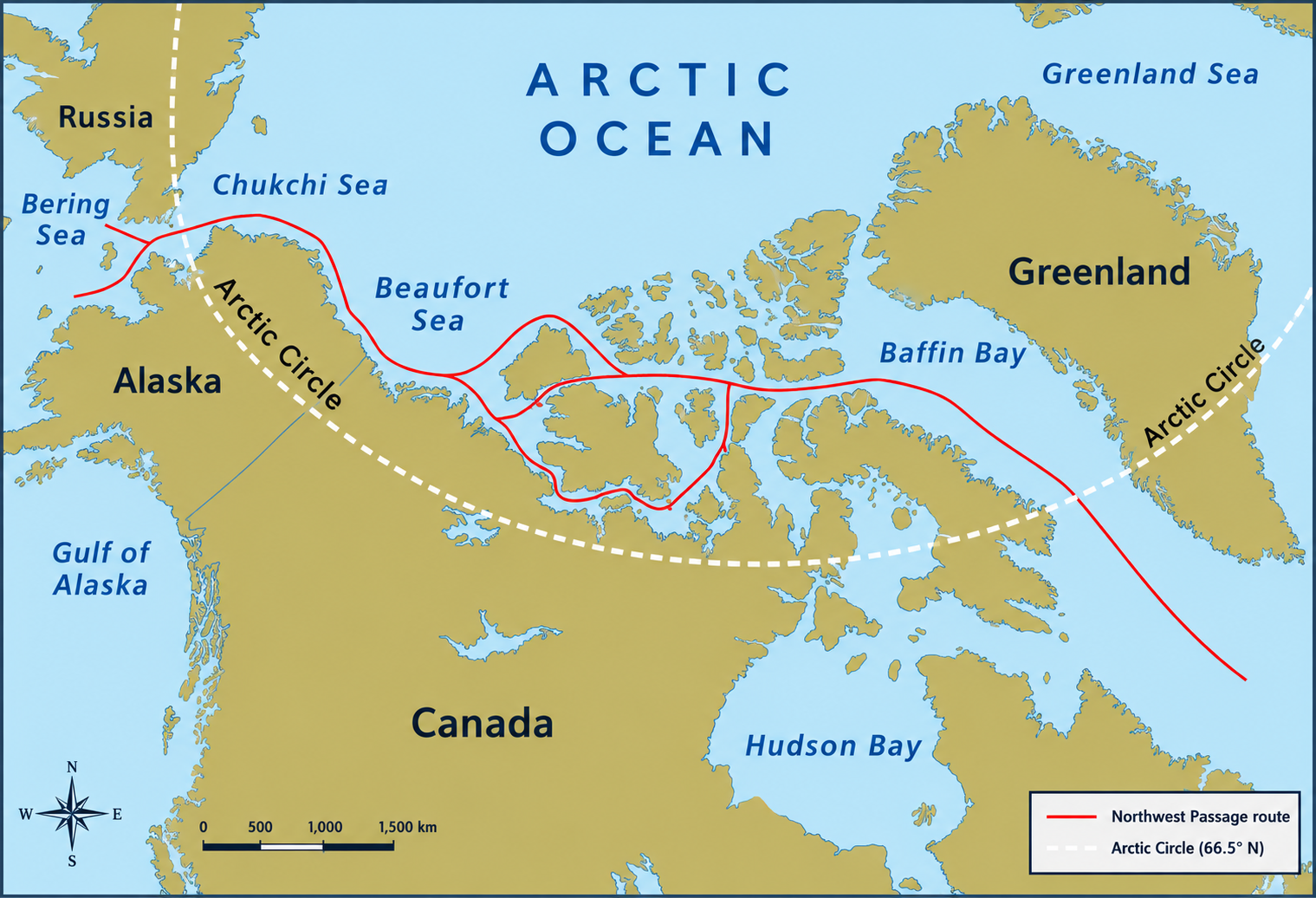
The Northwest Passage comprises several routes through Canada’s Arctic Archipelago linking the Atlantic and Pacific Oceans. Its attraction lies in its potential to shorten certain voyages between northern Atlantic and Pacific ports by around 10 days when compared with the route through the Panama Canal.[1] With the operational constraints of the latter, caused by declining water levels in the reservoirs supplying the Canal, potential time and costs saved may even increase in the years to come.[2] A consistent decline of Arctic sea ice means ever increasing opportunity for navigation, which is reflected on the increasing amount of non-scientific vessel transits.[3]
The legal status question:
Canada’s position on the Northwest Passage is part of its larger claim of sovereignty over the waters of the Arctic Archipelago. Straight baselines, drawn around the outer perimeter of the Archipelago and enclosing the Northwest Passage in Canada’s internal waters, came into effect in 1986.[4] Drawing of straight baselines beyond a 10 nautical mile limit was affirmed by the ICJ in the 1951 Fisheries case; however, it was emphasized that the lines must follow the general direction of the coast and that there must be a sufficient link between the enclosed maritime areas and the land domain.[5] There lies the possible problem in Canada’s claim, as the Arctic Archipelago carries little resemblance to the Norwegian skjærgaard in scale and in its geographical orientation and distribution.
The Canadian claims have several objectors including the UK and the EU[6], but the most vocal and persistent has been the United States. Their position is rooted partly in fears of setting a precedent for other international straits of critical importance, such as the Strait of Hormuz and the Straits of Malacca and Singapore.[7]
The dispute is managed by the 1988 Agreement on Arctic Cooperation, where the U.S. agreed to obtain Canada’s permission for intended icebreaker transits.[8] The requirement, however, was worded in a way which allows both sides to cooperate while still maintaining their respective positions. Since the Agreement, the two States have maintained a status quo, particularly due to lack of Canada’s enforcement capability and the U. S. avoiding a public challenge.[9] The Agreement, however, only governs icebreaker voyages and with increasing viability of commercial shipping through the Northwest Passage, it will likely become strained.[10]
In the Corfu Channel case, the ICJ established two elements for an international strait; geographical and functional. [11] The geographical element, the strait connecting two parts of the high seas, that is also embodied in Article 37 of the UN Convention on the Law of the Sea (UNCLOS), is hardly contestable, taking the Northwest Passage as a whole. The issue arises with the interpretation and application of the functional element; a strait being used for international navigation. While the Court disregarded the quantity of traffic as a determining factor, it nonetheless left open to interpretation whether the functional element referred to actual or potential use. [12] Another approach, if the Northwest Passage is taken as a series of straits, it could fit UNCLOS Article 45 criteria of a strait connecting a part of the high seas or EEZ and the territorial sea of a foreign State.[13]
The regulatory dilemma of Canadas powers over the NWP may also be subject to the special Arctic regime in UNCLOS Article 234, which allows a coastal State to adopt regulatory measures for prevention, reduction and control of pollution in ice-covered areas, but expert opinions on the applicability remain conflicted.[14]
IMPLICATIONS OF LEGAL STATUS:
If the Northwest Passage was considered a part of Canadian internal waters, Canada would exercise full sovereignty and could in principle decide whether, and on what conditions, foreign vessels may enter. Ordinary international navigation rights would not automatically apply, subject to the special rule in UNCLOS Art. 8(2).[15] This would give Canada the greatest scope to prescribe, authorise, monitor, and enforce environmental rules, while international governance would operate mainly through generally applicable instruments such as IMO conventions.
An Article 37 strait used for international navigation connects one part of the high seas or exclusive economic zone (EEZ) with another part of the high seas or EEZ. Such straits are subject to a regime of transit passage, meaning all ships have a non-suspendable right of continuous and expeditious transit.[16] Under this regime for the Northwest Passage, Canada would retain sovereignty and jurisdiction over the surrounding waters, seabed, subsoil, and airspace, but its laws and enforcement could not impede transit passage.[17]
An Article 45 strait regime would be non-suspendable innocent passage. Canada’s authority would therefore be broader than under Article 37. Under innocent passage, vessels must refrain from conduct prejudicial to Canada’s peace, order, or security, and Canada may legislate for safety and environmental protection. Yet Canada still could not suspend innocent passage through an Article 45 strait, so foreign ships would retain a legally protected right to pass, subject to the more demanding “innocence” standard.[18] In short, if the Northwest Passage is part of Canadian internal waters and not subject to Article 8(2) special rule, Canada retains full sovereignty and may legislate it how it sees fit. If it is an Article 45 strait, it is subject to a regime of innocent passage and if it is an Article 37 strait, it is subject to transit passage.
UNCLOS establishes different frameworks for environmental regulation under innocent passage and transit passage. Under Article 21(1)(f), a coastal State may adopt laws and regulations concerning the preservation of its marine environment and the prevention, reduction and control of pollution, subject to the limitations imposed by UNCLOS, including Article 21(2) concerning ship design, construction, manning and equipment, and Article 24 prohibiting measures that deny or impair innocent passage.
By contrast, the regulatory authority of States bordering straits subject to transit passage is more specifically circumscribed by Article 42(1)(b), which permits the adoption of pollution control regulations giving effect to applicable international regulations concerning the discharge of oil, oily wastes and other noxious substances. This limitation operates alongside Article 39(2)(b), which requires ships exercising transit passage to comply with generally accepted international pollution-prevention regulations, procedures and practices, and Article 42(2), which prohibits discriminatory or obstructive national regulations. Consequently, although both regimes accommodate marine environmental protection, UNCLOS affords States bordering straits less latitude to impose unilateral environmental requirements on foreign ships exercising transit passage than coastal States generally enjoy in regulating innocent passage through their territorial seas.
FUTURE GOVERNANCE
While a final resolution of the question of the status of the Northwest Passage seems desirable in order to achieve greater legal certainty and give clear mandates to the would-be legislator(s), it seems unlikely for the time being, due to the unwillingness of the U.S. and Canada to seek adjudication. In the meantime, it is becoming ever more critical to address the environmental concerns of Arctic shipping. In author’s opinion, the optimal regulatory framework depends on two factors: stringency and enforceability. While adopting the Canadian sovereignty position might seem like the optimal solution in terms of stringency, the enforceability is questionable due to the same strategic reasons that currently keep the status quo with the U. S.[19] A better balance might be struck with a strong framework under the relevant provisions of UNCLOS, the IMO Polar Code[20], MARPOL convention[21] and other applicable provisions of international law, with Canadian domestic legislation giving rise to those measures in the field would have stronger enforceability with international backing both in legal and practical terms, while maintaining a high enough degree of stringency to effectively protect the Arctic environment.
Bibliography
Byers, Michael; Lalonde, Suzanne: Who Controls the Northwest Passage?, v: Vanderbilt Journal of Transnational Law, 42 (2009) 4, pp. 1133–1210.
Commission of the European Communities: Communication from the Commission to the European Parliament and the Council – The European Union and the Arctic Region, COM(2008) 763 final, Brussels (20. November 2008).
Fuentes, Gabriel; Munim, Ziaul Haque: Climate influence on Panama Canal operations: Predicting canal water times with integrated environmental and operational data, in: Transportation Research Part E: Logistics and Transportation Review, 203 (2025), article no. 104319.
Howson, Nicholas C.: Breaking the Ice: The Canadian-American Dispute over the Arctic’s Northwest Passage, in: Columbia Journal of Transnational Law, 26 (1988) 2, str. 337–375.
Kraska, James: The Law of the Sea Convention and the Northwest Passage, in: The International Journal of Marine and Coastal Law, 22 (2007) 2, str. 257–282.
Lajeunesse, Huebert, Preparing for the next Arctic sovereignty crisis (2019), pp. 225–239.
Okoye, What Is the Status of the Northwest Passage in the Arctic Under International Law of the Sea?, URL: <https://papers.ssrn.com/sol3/papers.cfm?abstract_id=4103818>
Lalonde, Suzanne; Lasserre, Frédéric: The Position of the United States on the Northwest Passage: Is the Fear of Creating a Precedent Warranted?, in: Ocean Development & International Law, 44 (2013) 1, str. 28–72.
Mundy, Maryanne: The Polar Express Lane: Promoting Cleaner Shipping in The Northwest Passage, in: The Georgetown Environmental Law Review, 29 (2016) 1, str. 153–183.
Okoye, Uchechukwu: What Is the Status of the Northwest Passage in the Arctic Under International Law of the Sea?, SSRN (2022), URL: https://papers.ssrn.com/sol3/papers.cfm?abstract_id=4103818 (28. oktober 2026).
Rodrigue, Jean-Paul: Polar Shipping Routes, The Geography of Transport Systems, URL: https://transportgeography.org/contents/chapter1/transportation-and-space/polar-shipping-routes/ (28. oktober 2026).
Transit Statistics, The North West Passage, URL: https://thenorthwestpassage.info/transit-statistics/ (28. oktober 2026).
Türk, Danilo: TEMELJI MEDNARODNEGA PRAVA (2., pregledana in dopolnjena izdaja), IUS Software, GV Založba, Ljubljana 2015.
Endnotes
* This article is based on a presentation delivered at the "ClimateXLaw" conference, held at the Faculty of Law, University of Ljubljana, on September 10–11, 2026.
** Master’s student at the University of Ljubljana, Faculty of Law.
[1] Rodrigue, Polar Shipping Routes, URL: <https://transportgeography.org/contents/chapter1/transportation-and-space/polar-shipping-routes/>.
[2] Fuentes, Munim, Climate influence on Panama Canal operations (2025), article no. 104319.
[3] <https://thenorthwestpassage.info/transit-statistics>.
[4] Territorial Sea Geographical Coordinates (Area 7) Order, SOR/85-872, s. 4(1), Schedule I, effective 1 January 1986.
[5] Fisheries (United Kingdom v. Norway), Judgment, I.C.J. Reports 1951, p. 116, at pp. 128, 133.
[6] Commission of the European Communities, The European Union and the Arctic Region (2008), pts. 3.3 and 4.
[7] Howson, Breaking the Ice: The Canadian-American Dispute over the Arctic’s Northwest Passage (1988), p. 337; Kraska, The Law of the Sea Convention and the Northwest Passage (2007), p. 279.
[8] Agreement between the Government of Canada and the Government of the United States of America on Arctic Cooperation, signed at Ottawa on 11 January 1988, Canada Treaty Series 1988 No. 29, paras. 3–4.
[9] Lajeunesse, Huebert, Preparing for the next Arctic sovereignty crisis (2019), pp. 225–239.
[10] Okoye, What Is the Status of the Northwest Passage in the Arctic Under International Law of the Sea?, URL: <https://papers.ssrn.com/sol3/papers.cfm?abstract_id=4103818>
[11] Corfu Channel (United Kingdom of Great Britain and Northern Ireland v. Albania), Merits, Judgment, I.C.J. Reports 1949, p. 4, at p. 28.
[12] Lalonde, Lasserre, The Position of the United States on the Northwest Passage (2013), pp. 28–72.
[13] Mundy, The Polar Express Lane (2016), p. 166.
[14] Byers, Lalonde, Who Controls the Northwest Passage? (2009), pp. 1182–1183.
[15] United Nations Convention on the Law of the Sea (UNCLOS), adopted at Montego Bay on 10 December 1982, 1833 UNTS 3, Art. 8(2).
[16] Türk, TEMELJI MEDNARODNEGA PRAVA (2015), str. 358.
[17] UNCLOS, Arts. 37, 38 and 42.
[18] UNCLOS, Art. 45.
[19] Lajeunesse, Huebert, supra 9, pp. 225–239.
[20] International Code for Ships Operating in Polar Waters (Polar Code), IMO Resolutions MSC.385(94), adopted on 21 November 2014, and MEPC.264(68), adopted on 15 May 2015.
[21] International Convention for the Prevention of Pollution from Ships, 1973, as modified by the Protocol of 1978 relating thereto (MARPOL 73/78), 1340 UNTS 184.